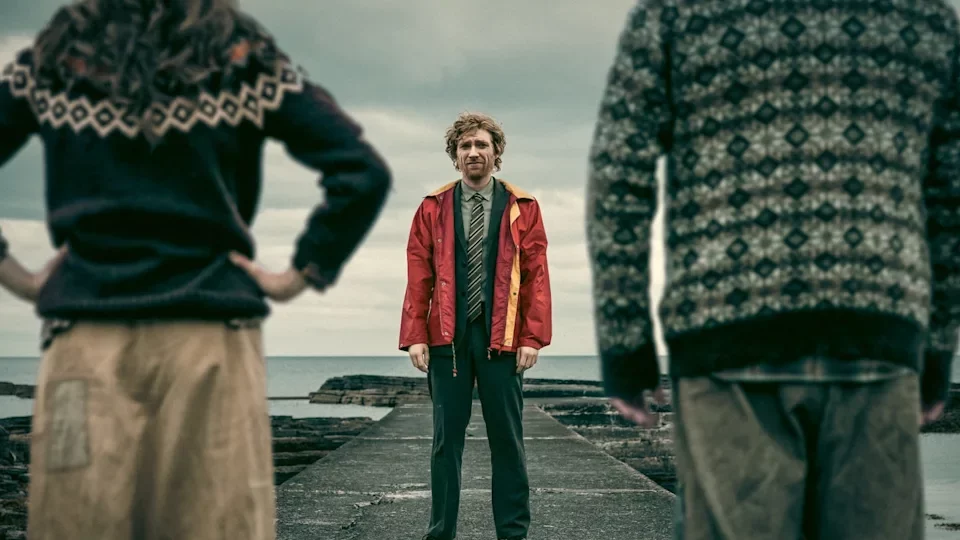
There is something immediately strange and endearing about The Incomer. Louis Paxton’s feature debut takes place on a remote Scottish island where siblings Isla and Sandy have spent years living almost entirely apart from the modern world, surviving by hunting seabirds, preserving the stories passed down by their parents and doing everything they can to keep the dreaded “Incomers” away. It is eccentric from the beginning, but beneath all the gull costumes, folklore and wonderfully odd humour is a surprisingly heartfelt story about grief, isolation and change.
Isla, Sandy and Daniel
Gayle Rankin and Grant O’Rourke play Isla and Sandy, whose carefully protected existence is interrupted by the arrival of Daniel, an awkward council worker played by Domhnall Gleeson. He has been sent to inform them that they must leave the island on behalf of the local authority, although the conversation does not exactly go to plan when Isla responds to his arrival by knocking him unconscious with a rock.

From there, The Incomer becomes a wonderfully unusual collision between two completely different worlds. Daniel arrives armed with paperwork and knowledge of supermarkets, Wi-Fi and life on the mainland, only to find himself dealing with siblings whose understanding of the outside world comes largely from stories, assumptions and whatever their father taught them growing up. Sandy is immediately fascinated by almost everything Daniel tells him, whereas Isla is far more suspicious.
That contrast gives Paxton’s script some of its funniest moments. Much of the comedy comes from watching Daniel attempt to explain things most people would never think twice about, met with complete sincerity from Sandy and considerably more hostility from Isla. The film never needs to push those laughs because Rankin, O’Rourke and Gleeson understand exactly how strange the situation already is, and some of the funniest moments come from simply letting the three of them exist together.
O’Rourke is especially funny as Sandy, bringing an infectious curiosity to someone discovering that the world might contain more than the island he has known all his life. There is something almost childlike about his excitement without the performance ever becoming a caricature. That quality exists in both siblings, though, and it says something much sadder about how isolated they have been. Their lives have almost been preserved in the form they took after losing their parents, leaving Isla and Sandy as adults who are capable of surviving entirely on their own but still carry parts of the children they once were.
Rankin has the more guarded role as Isla and is brilliant at balancing vulnerability with someone genuinely formidable. Isla can be funny, aggressive and completely unreasonable within the same scene, but Rankin gradually reveals how much fear and grief sit underneath her determination to protect Sandy and their home. Her resistance to the mainland is not simply stubbornness. Leaving means questioning everything their parents taught them and accepting that the life she has fought so fiercely to preserve cannot continue forever.
The relationship between Isla and Sandy is one of my favourite parts of the film. They bicker, fight and frustrate each other constantly, but there is so much affection underneath it. Rankin and O’Rourke make them feel like siblings who have spent years with nobody else around, complete with their own rhythms, shared stories and ways of understanding one another. Sandy’s growing fascination with everything beyond the island naturally begins to pull against Isla’s determination to keep their world exactly as it is, bringing more emotion to their relationship as the film goes on.
Gleeson is brilliantly awkward as Daniel. From the moment he arrives, he seems completely out of his depth, and his restrained reactions make Isla and Sandy’s behaviour even funnier. He is also an outsider in his own way. The mainland might offer avocados, Wi-Fi and considerably fewer gulls for dinner, but it has not necessarily given him any greater sense of belonging.
That becomes increasingly important because Daniel is not there only to change Isla and Sandy. They change him too. As his initial terror softens into curiosity and affection, the film becomes something beyond a straightforward story about two isolated people being introduced to modern life. All three are lonely in different ways, and each begins to find something in the others that they were missing.
Folklore and Life on Auk Isle
The island itself is just as important. Shot against Scotland’s wild coastline, the landscape can look beautiful one moment and intimidating the next, fitting perfectly with a story in which the place represents both home and something Isla has become trapped by. Paxton makes the isolation feel tangible, but never makes you wonder why somebody might fight so hard to remain there.
Paxton also brings Scottish folklore into the film through the Fin Man, played by John Hannah, a figure Isla has known through stories since childhood. What initially feels like another wonderfully strange part of the island becomes something sadder, revealing how tightly grief, memory and the stories handed down by her parents have become tangled together. The mythology gives The Incomer the feeling of a slightly warped Scottish fairytale, where it is not always entirely clear where family folklore ends and reality begins.
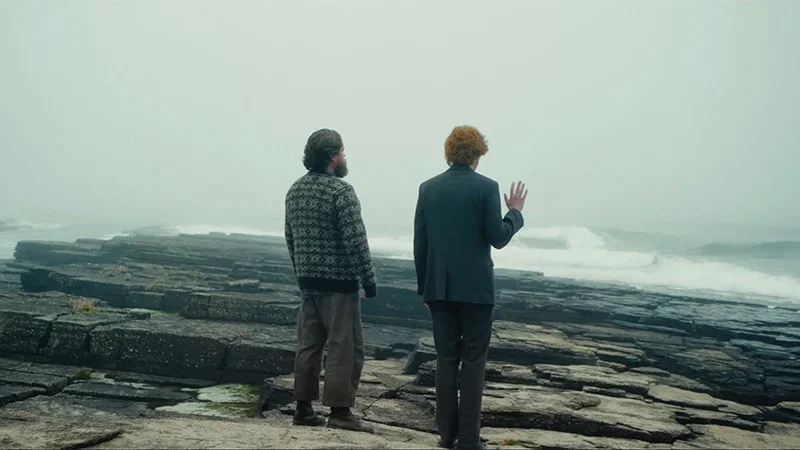
What works particularly well is that The Incomer never treats Isla and Sandy simply as people who need to be “fixed” by the modern world. Daniel introduces them to possibilities they have never considered, but he also begins to understand what their life on the island has given them. There is freedom in Sandy discovering what exists beyond Auk Isle, but there is something equally important in Daniel recognising that the mainland does not automatically provide happiness or connection simply because it has more people on it.
When the Council Comes Calling
Michelle Gomez also has enormous fun as Daniel’s ruthless boss Roz, bringing the kind of sharp, slightly terrifying energy you would hope for, with Emun Elliott appearing as council enforcer Calum. Their arrival pushes the film into much broader comedy, particularly as the conflict between the island and the council escalates. It is deliberately bigger and sillier than much of what comes before, and although that shift occasionally jars with the gentler oddness of the central story, both performers completely commit to it.
There are a few moments where the film’s balance is not quite as smooth. Daniel’s own development could have been given a little more room, particularly when compared with how fully Isla and Sandy are explored, and some sequences linger slightly longer than they need to. The later council material also moves into a different register from the quieter comedy that works so well earlier on. None of that does much to undermine the film, though, particularly when its central trio are so enjoyable together.
For CultureCues, The Incomer was one of those festival films that really won us over. It is proudly weird, very Scottish and genuinely funny, but there is a tenderness underneath everything that gives even its strangest moments meaning. Rankin, O’Rourke and Gleeson are brilliant together, with O’Rourke frequently stealing scenes through Sandy’s sheer enthusiasm for every new discovery and Rankin giving Isla far more vulnerability than her rather aggressive approach to visitors first lets on.
More than anything, I loved that this ultimately became a story about three people trying to work out where they belong. Isla believes home is something that has to be protected from change, Sandy begins to wonder whether his might extend beyond the island, and Daniel slowly discovers that belonging is not necessarily tied to the place you come from at all. Beneath the Fin Men, gull hunting and council eviction notices, there is a very simple idea about finding your people, and that is where The Incomer really landed for me.
Having already picked up the NEXT Innovator Award at Sundance, The Incomer arrived at EIFF with plenty of praise behind it, and it is easy to understand why. Paxton has made a confident and wonderfully peculiar first feature about home, family and finding the courage to look beyond the stories you have always been told. We laughed a lot, cared about this deeply odd little family and left rather fond of Isla, Sandy, Daniel and their strange little corner of Scotland.
CultureCues Rating: ★★★★☆ (4/5)

Nikki Murray is a UK-based writer, screenwriter and founder & editor of CultureCues, covering film, television, music and pop culture. Her work focuses on storytelling and the moments shaping modern entertainment.