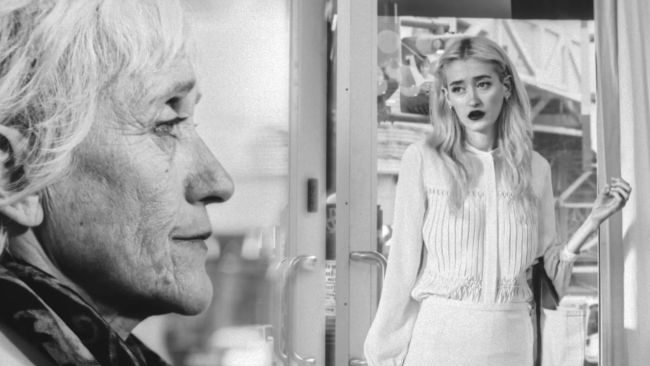
The Arrow at Rest at Every Instant of its Flight is one of those films where, for quite a lot of the runtime, you may find yourself wondering what exactly you are watching. Theodore Schaefer’s second feature is strange, funny, philosophical and deliberately unpredictable, moving between three seemingly disconnected stories across New York City before gradually revealing the ideas tying them together.
I watched the film as part of the Out of Competition strand at the Edinburgh International Film Festival, where it had its world premiere. Shot in black and white on 16mm and accompanied throughout by an erratic jazz score, it immediately establishes its own very distinctive rhythm. I did not always know where it was taking me, but that became a large part of what made it so interesting.
Spoiler warning: This review contains spoilers for The Arrow at Rest at Every Instant of its Flight.
Three Stories Across New York
Gus Birney takes on three separate roles across the film, beginning with Violet, a deeply fed-up arcade worker trapped in a job she cannot stand. She and her equally disillusioned co-worker, played by Jack Haven, spend their days dealing with customers, questioning how anybody is supposed to afford rent or food and dreaming up increasingly ridiculous ways of making enough money to escape.
Their conversations are some of the funniest parts of the film. There is a dark humour running through their desperation, particularly as ideas about robbery gradually turn into a plan to pose as charity collectors for a completely invented climate organisation. When they arrive in a wealthy neighbourhood, they discover somebody else has apparently had much the same idea.
That first story introduces many of the questions Schaefer and co-writer Patrick Lawler keep returning to. What do people actually want from life? Money? Love? Faith? Freedom? At one point, the characters compare people to claw machines, endlessly grabbing at things and dropping them again. It is a funny image, but it also becomes a surprisingly effective way of describing almost everybody we meet.
The second story introduces Sinopia, also played by Birney, an upper-class professor increasingly dissatisfied with her marriage. It is quieter and more reflective, looking at relationships, desire and the difficulty of understanding what another person wants. The film circles around the complexity and beauty of life, often undercutting those bigger ideas with something odd or funny.
Then there is Jade, Birney’s third character, a pickpocket whose latest theft takes the film somewhere darker when she discovers what appears to be a suicide note inside a stranger’s wallet. Rather than simply walking away, she becomes determined to help, eventually finding herself involved in a poker game in an attempt to solve somebody else’s financial problems.
Gus Birney Takes on Three Very Different Roles
Birney is excellent throughout and gives each of the three women enough individuality that they never feel like variations of the same character. Violet has this sarcastic frustration with the world around her, Sinopia is much more restrained and reflective, and Jade carries herself with a confidence that makes her feel completely different again. Watching Birney move between them also becomes important as the film progresses. These initially separate stories begin to echo one another through repeated ideas, imagery and references to bows and arrows, all connecting back to that enormous title.
Constance Shulman, Birney’s real-life mother, adds another layer of strangeness as the unnamed woman with a suitcase who wanders through New York asking people whether they have seen her. She believes a doppelgänger is trying to take over her life, but nobody she approaches seems to recognise her or understand what she is talking about. Her appearances initially seem almost completely separate from everything else, but the closer the film gets to its ending, the more important she becomes.
Jack Haven is also very funny as Violet’s arcade co-worker, playing the character with a very dry, sarcastic edge and plenty of dark humour. They have essentially decided the arcade is hell and spend most of their time trying to work out how to escape it, with Haven making even the bleakest observations land comedically. Their scenes with Violet have a great rhythm, especially as their money problems push them towards increasingly questionable ideas, and Haven plays that mixture of frustration, sarcasm and desperation really well.
A Film That Gets Stranger as It Goes
Theodore Schaefer does not make things particularly easy for the audience, but that is also part of the fun. Scenes can suddenly change direction, philosophical conversations sit beside very dark jokes and moments that seem grounded can become completely surreal without warning.
There is one wonderfully ridiculous moment where Violet apparently kills an attacker with a karate chop, paying off an earlier conversation about somebody supposedly dying in that way. It is played so casually that it somehow becomes even funnier. Then there is the poker sequence, which may be the moment where I accepted that there was no point trying to predict what this film was going to do next. What begins as a relatively normal card game suddenly changes as the tension builds, with the playing cards revealing bizarre and occasionally explicit images instead of anything you would expect to find in a standard deck.
The black-and-white photography, rapid editing and jazz score all help create that sense of unpredictability. The music can feel restless and almost chaotic at times, matching characters who are themselves constantly searching for something they cannot quite define.
Beneath all of that strangeness, however, there is a surprisingly thoughtful film about people trying to escape their circumstances. Violet wants out of her job and financial situation. Sinopia questions the life and relationship she has created. Jade becomes caught up in another person’s desperation, and the woman with the suitcase is quite literally searching for another version of herself.
Ideas around faith and mortality appear too, including the striking suggestion that death is like an arrow already in flight and that our lives last only until it finally reaches us. It sounds extremely heavy written down, but Schaefer repeatedly finds ways to place those ideas beside comedy and absurdity.
The ending pushes the surrealism even further. After spending almost the entire film in black and white, colour suddenly appears during the final minutes. Jade seems to become the older woman with the suitcase, the people around her freeze in place and she walks through them before eventually addressing the audience directly.
That final breaking of the fourth wall brings the film’s questions around time, identity and connection together without necessarily providing a neat explanation for everything we have just watched. I am not entirely sure a neat explanation would suit it anyway.
For CultureCues, The Arrow at Rest at Every Instant of its Flight is undeniably strange, but it is also a very interesting piece of filmmaking. There were moments where I had absolutely no idea what was coming next, and I quite enjoyed that. Gus Birney is brilliant across three very different roles, Jack Haven gets some of the biggest laughs and Theodore Schaefer delivers a really impressive piece of direction, bringing all of the film’s unusual ideas and shifting stories together with confidence. It will probably not work for everybody, particularly if you want a straightforward narrative, but I found myself increasingly intrigued by the way its stories, characters and recurring ideas started connecting. Even after it ended, I was still thinking about what some of those connections meant, which feels appropriate for a film so interested in the way individual moments eventually become something bigger.
I also had the chance to sit down with director Theodore Schaefer and Jack Haven during EIFF to talk about the film and its unusual structure. Keep an eye on CultureCues for the interview coming soon.
CultureCues Rating: ★★★★☆ (4/5)
The Arrow at Rest at Every Instant of its Flight had its world premiere at the Edinburgh International Film Festival on 14th August 2026.

Nikki Murray is a UK-based writer, screenwriter and founder & editor of CultureCues, covering film, television, music and pop culture. Her work focuses on storytelling and the moments shaping modern entertainment.