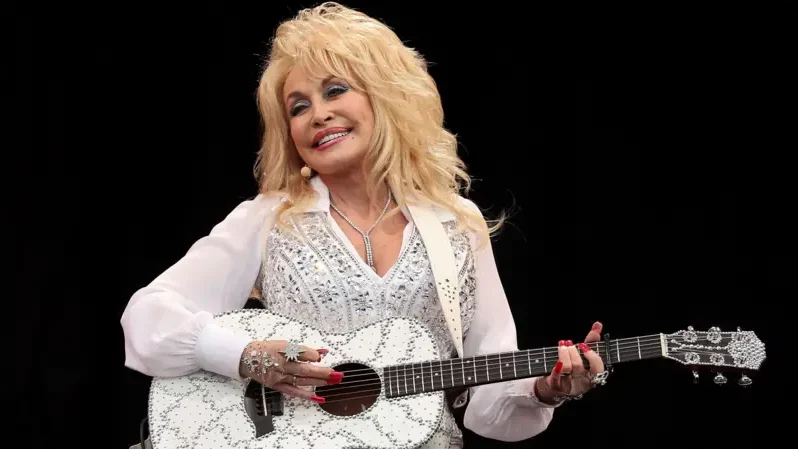
Dolly Parton, one of the most beloved and influential figures in music and pop culture, has died aged 80. The legendary singer, songwriter, actress and philanthropist died in Nashville on Tuesday, 25 August. Her death was announced by her nephew Bryan Seaver on behalf of the Parton family, bringing an extraordinary career spanning almost seven decades to a close.
Parton’s official social channels later shared a final message to the millions of people who loved her around the world. In five words that could hardly have been more fitting, it simply read: “I will always love you.”
For generations of fans, Dolly Parton was so much more than a country music star. From Jolene, Coat of Many Colors and 9 to 5 to I Will Always Love You, her songs became part of popular culture in their own right, crossing genres, generations and borders. Her unmistakable voice, huge blonde hair, rhinestones and brilliantly self-aware sense of humour made her instantly recognisable, but behind the larger-than-life image was one of the great songwriters of her generation.
Born in Tennessee in 1946 as one of 12 children, Parton began making music when she was still a child and moved to Nashville at 18. Her partnership with Porter Wagoner helped introduce her to a national audience before she established herself as a solo star, with songs including Jolene and Coat of Many Colors cementing her place in country music.
I Will Always Love You, originally written as Parton’s farewell to Wagoner, reached number one on the country chart for Parton and later became one of the most famous songs ever recorded when Whitney Houston released her version in 1992. It was typical of Parton’s songwriting that a song written from such a personal moment could go on to mean something entirely different to millions of people.
Her success extended far beyond country music. 9 to 5 took Parton to Hollywood in 1980 alongside Jane Fonda and Lily Tomlin, with the title track becoming another of her defining songs. Roles in The Best Little Whorehouse in Texas and Steel Magnolias followed, and decades later she remained a familiar presence on television, including appearances alongside her goddaughter Miley Cyrus in Hannah Montana.
Parton never stopped finding new audiences either. She headlined Glastonbury’s Pyramid Stage in 2014 in one of the festival’s most memorable Sunday afternoon sets, was inducted into the Rock & Roll Hall of Fame in 2022 and responded by doing perhaps the most Dolly thing possible: deciding she should make a rock album to prove she deserved it. Rockstar followed in 2023, featuring everyone from Paul McCartney and Ringo Starr to Elton John, Miley Cyrus and Lizzo, and became the highest-charting album of her career on the Billboard 200.
Her influence, though, cannot really be measured through chart positions and awards alone.
Parton built Dollywood into one of Tennessee’s best-known attractions, but some of her most important work happened away from the stage. She founded Dolly Parton’s Imagination Library in 1995, initially inspired by her father’s inability to read and write, with the programme sending free books to young children and eventually expanding around the world, including across the UK.
She also donated $1 million to Vanderbilt University Medical Center during the COVID-19 pandemic, helping support research connected to the Moderna vaccine, and repeatedly used both her platform and her success to support communities and causes close to her heart.
That generosity was as much a part of Dolly as the music. She could be glamorous and ridiculous, deeply sincere and incredibly funny, often all within the same conversation. Few stars have ever understood their own public image quite as well, and fewer still managed to become such an enormous celebrity without ever seeming to lose the warmth and humour that first made people love them.
Her nephew Bryan Seaver reflected on that impact following her death, saying: “By her example, we believed anything was possible.” He added that she had opened doors that “made and changed history.”
Those doors were particularly important for generations of women who followed her into country music and beyond. Parton owned her songs, protected her publishing and built a career on her own terms at a time when the industry offered women less control. Artists across country, pop and rock have cited her as an influence, and her songs have been covered by everyone from Whitney Houston and The White Stripes to Beyoncé.
Parton continued working into her final years. Her 2024 project Smoky Mountain DNA: Faith, Family and Fables brought together her extended family, and after husband Carl Dean died in March 2025, she released the personal If You Hadn’t Been There. They had been married for nearly 60 years.
She was also preparing to bring her life story to Broadway with DOLLY: A True Original Musical, featuring both new material and songs from across her career.
For CultureCues, it is difficult to think of many people who have meant so much to so many different generations. Dolly was country music, but she was also film, television, fashion, comedy, songwriting and pure pop culture. You did not have to consider yourself a country fan to know Jolene, sing 9 to 5 or recognise that voice within seconds. And beyond all of it, there always seemed to be a genuine kindness to her that made people feel incredibly fond of the person as well as the star.
She was funny, glamorous, endlessly quotable and completely herself. A true original in every sense, and a pop culture icon whose influence will be felt for generations. Dolly Parton will be enormously missed. And really, there is only one way to say goodbye.
We will always love you, Dolly.

Nikki Murray is a UK-based writer, screenwriter and founder & editor of CultureCues, covering film, television, music and pop culture. Her work focuses on storytelling and the moments shaping modern entertainment.