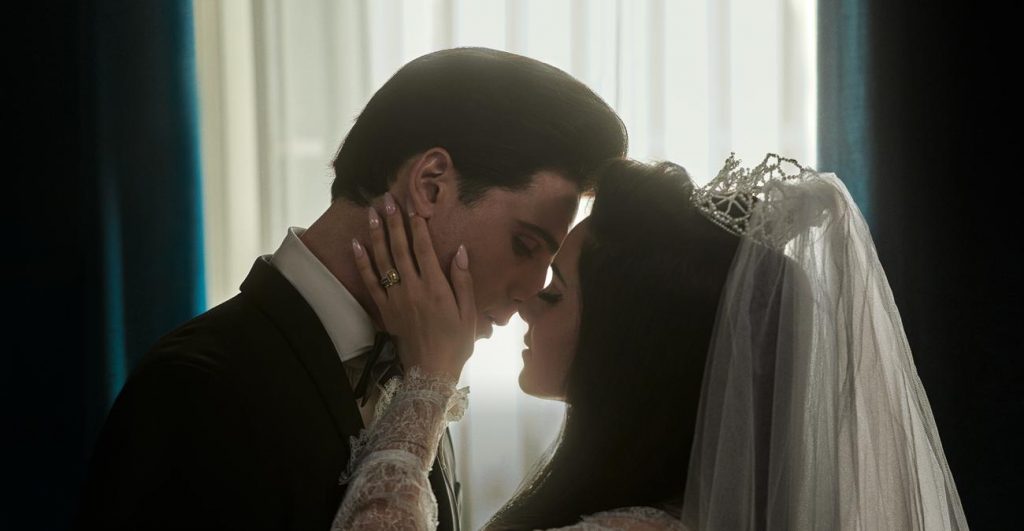
From its very first image, Priscilla feels unmistakably like a Sofia Coppola film. Soft textures, pastel tones, and a kind of dreamlike stillness draw you in, but beneath that surface is something far more complex. This is not a traditional biopic, nor is it a sweeping love story. Instead, it’s a quiet, interior look at one young woman’s experience of being pulled into the orbit of one of the most famous men in the world.
A story told from the inside
Based on Elvis and Me, the film follows Priscilla Beaulieu (Cailee Spaeny) from the moment she meets Elvis Presley (Jacob Elordi) as a teenager living on a US Army base in Germany. At fourteen, she is bored, restless, and searching for something more, while he is already a global icon, existing in a world of fame and attention that feels worlds away from her own. Coppola doesn’t frame their relationship in a dramatic or sensational way. Instead, she presents it as it unfolds, almost like a diary. Moments drift into one another, sometimes quietly, sometimes uneasily, allowing the audience to sit with Priscilla’s perspective rather than imposing a clear judgement.
What begins as something exciting and almost surreal slowly shifts into something more complicated. The film captures how easy it is to be swept up in attention, especially at that age, and how difficult it becomes to separate that feeling from who you are.
A relationship built on imbalance
Jacob Elordi’s Elvis is not the larger-than-life performer audiences might expect, but instead comes across as controlled, soft-spoken, and at times strangely distant, with a gentleness that initially feels reassuring but gradually reveals a clear need for control. As their relationship develops, that imbalance becomes harder to ignore, with Elvis shaping almost every aspect of Priscilla’s life, from her appearance to her daily routine, often under the guise of care and protection. She is given everything she could want in a material sense, yet very little space to define herself or make her own choices, and it’s this quiet restriction that sits at the heart of the film. Coppola never pushes this too far or spells it out directly, instead allowing it to unfold naturally over time, which makes it feel all the more affecting and difficult to shake.
A performance that holds everything together
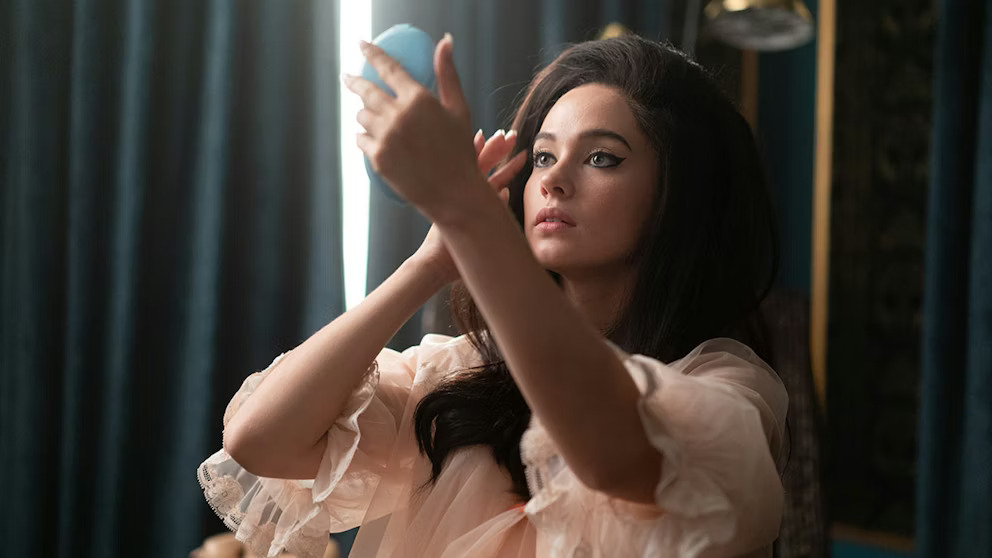
Cailee Spaeny is quietly remarkable as Priscilla. It’s a performance built on subtle shifts, small expressions, and moments that say more in silence than dialogue ever could. You see her grow up on screen, not just physically, but emotionally, as she begins to understand the reality of the life she’s in. There’s a strength to her performance that never feels forced. Instead, it builds slowly, reflecting the character’s journey from someone who is easily shaped by the world around her to someone who begins to question it.
Style that says more than words
Visually, the film is stunning in a way that feels effortless. Coppola has always had a strong sense of aesthetic, but here it feels particularly purposeful. The softness of the imagery, the careful use of colour, and the dreamlike montages all mirror Priscilla’s experience, the feeling of being both inside something beautiful and slightly removed from it. Music plays a key role too, though not always in the way you might expect. Rather than leaning heavily on Elvis’s own songs, the film uses a mix of instrumental covers and carefully chosen tracks to create atmosphere, adding to that sense of distance.
CultureCues Final thoughts
One of the most affecting moments comes towards the end, when everything begins to shift and Priscilla finally starts to see her life more clearly. There’s no dramatic confrontation or sudden turning point. Instead, it’s a quiet realisation, built from everything that has come before. When she finally leaves Graceland, it doesn’t feel like a big cinematic escape. It feels small, personal, and incredibly significant. After spending so much of the film watching her exist within someone else’s world, that moment of stepping into her own life lands in a way that feels both understated and powerful.
Priscilla is not interested in spectacle or easy answers. It’s a film about experience, about how relationships can shape you, and about what it means to slowly find your way out of something that once felt like everything. It’s beautiful, sometimes uncomfortable, and quietly devastating in places. But what makes it stand out is its restraint. It trusts the audience to sit with what’s being shown, rather than spelling it out.
Priscilla arrived in UK cinemas on 1 January 2024.

Nikki Murray is a UK-based writer, screenwriter and founder & editor of CultureCues, covering film, television, music and pop culture. Her work focuses on storytelling and the moments shaping modern entertainment.