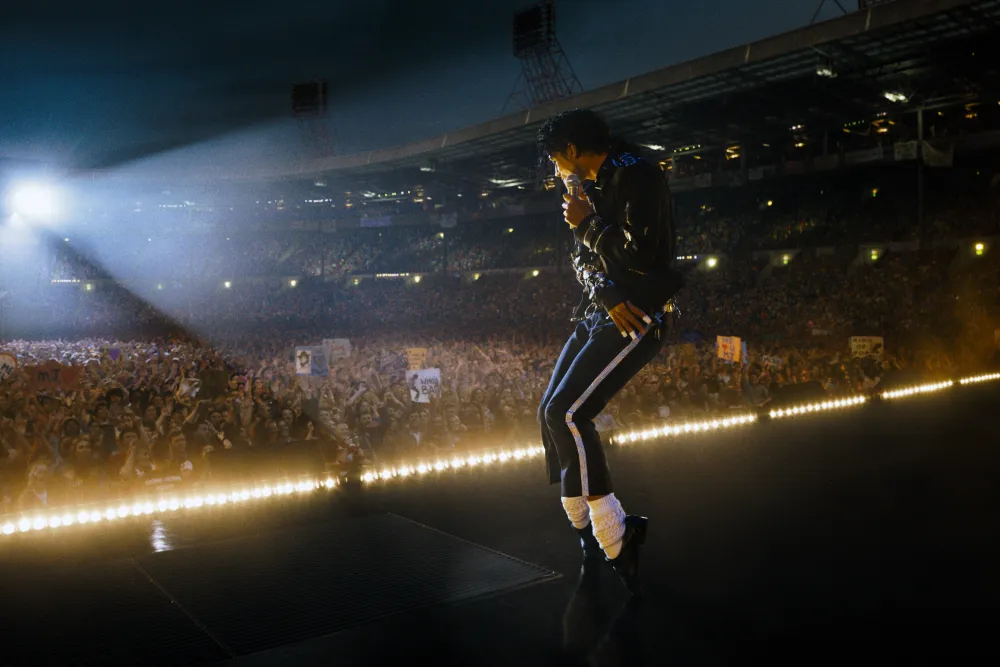
Michael was always going to arrive with noise around it. A Michael Jackson biopic could hardly do anything else. Directed by Antoine Fuqua and starring Jackson’s nephew Jaafar Jackson, the long-delayed film has become a major box office force, crossing more than $200 million worldwide and setting records for a biographical film opening. It has also opened up one of the sharpest critic-audience divides of the year, with critics largely unimpressed while fans have turned screenings into celebratory events.
That split says almost everything about the film itself. As cinema, Michael is frustratingly safe, often too polished and too careful to feel truly revealing. As a fan experience, though, it is much easier to understand why audiences are responding to it with such emotion. This is a film built around recognition: the songs, the steps, the silhouette, the glove, the hat, the impossible weight of a cultural figure who still feels larger than almost anyone around him.
A Biopic With Big Spectacle and Bigger Avoidance
The film follows Jackson from his childhood in The Jackson 5 through to the height of his solo superstardom, with the story ending around the late 1980s. That choice gives Michael a clear shape, but it also creates an obvious limitation. This is not a film that really wants to sit with the full complexity of Jackson’s life, public image or legacy. It gestures towards pain, pressure, childhood abuse, loneliness and fame, but it rarely stays with any of those things long enough to make them feel fully explored.
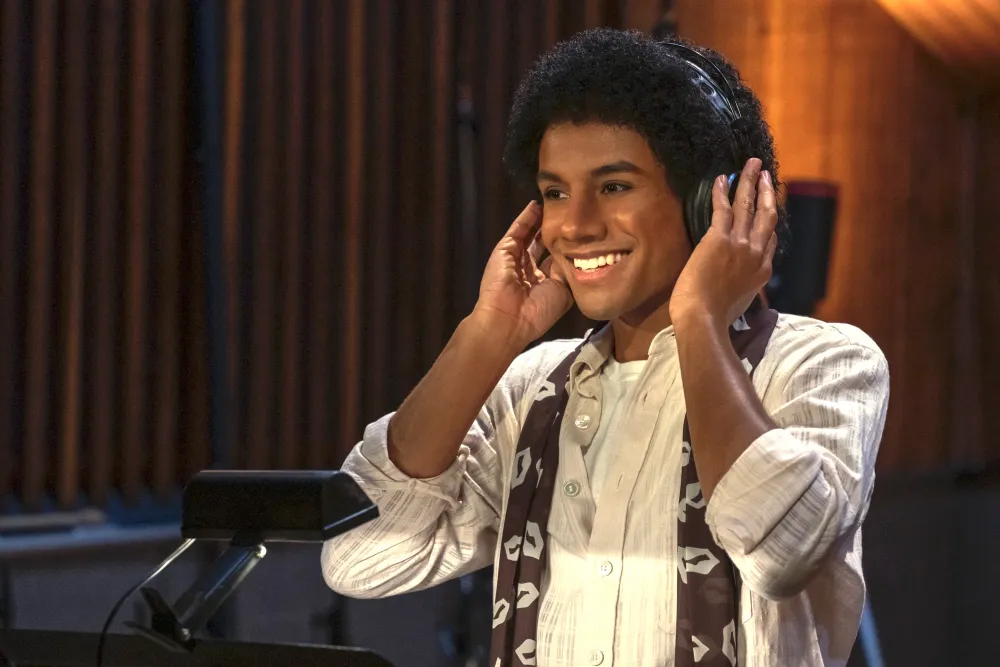
There are moments where a sharper, stranger and more honest film seems to be trying to break through. The early scenes with young Michael, played by Juliano Krue Valdi, are among the most effective in the film because they capture the awful contradiction at the centre of child stardom: the joy of performance sitting right beside fear, control and exhaustion. Valdi gives the younger Michael a real sense of vulnerability, and there is a sadness in watching a child discover that his gift is also the thing trapping him.
As the film moves forward, it becomes more interested in Michael Jackson the celebrity than Michael Jackson the person. We see the rise, the records and the famous stage recreations, but we do not always get a sense of what Michael is thinking, or what he wants beyond success. For a film about one of the most innovative entertainers of the twentieth century, Michael can feel oddly uninterested in the creative process.
Jaafar Jackson Is the Film’s Biggest Strength
The obvious talking point is Jaafar Jackson, and he is easily the film’s strongest asset. His resemblance to Michael is startling at times, but the performance works best when it goes beyond surface-level imitation. He captures the physical language beautifully: the stillness before movement, the delicacy of the speaking voice, the stage presence that could make a simple turn of the head feel choreographed.
The concert and video recreations will be a major reason fans return for repeat viewings, especially on the biggest screen possible. There is genuine pleasure in seeing those familiar moments rebuilt for the big screen, and at its best, Michael understands the thrill of watching a performer become almost mythic in front of an audience. For fans who never had the chance to see Jackson live, it is not hard to see why the film has been described by some viewers as the closest thing to a concert experience.
Nia Long brings warmth and steadiness as Katherine Jackson, while Colman Domingo gives Joe Jackson an intensity that cuts through the film’s more polished edges. The problem is that the script often flattens both characters into fixed roles: the loving mother, the cruel father, the loyal lawyer, the admiring executive. There is strong acting here, but not always enough complexity for the cast to really play with.
Where the Film Falls Short
The main issue with Michael is not that it is reverent. A music biopic can be openly affectionate and still be great. The issue is that it often feels managed. The film is so determined to present Jackson as gifted, wounded and misunderstood that it sometimes forgets to make him feel like a fully complicated person. That is especially noticeable in the way the film handles his eccentricities, his isolation and his relationships with the people around him. Instead of digging into the contradictions, it smooths them out.
Instead of asking difficult questions about fame, power, family, race, childhood and control, it often moves quickly towards another familiar song or another famous image.
There is also the unavoidable context of what the film leaves outside the frame. Because Michael ends before the later allegations against Jackson became part of the public record, it avoids the most controversial aspects of his legacy. Critics have strongly challenged that approach, particularly given the film’s estate-backed nature and its clearly affectionate framing. For some audiences, that will make the film feel incomplete. For others, especially devoted fans, the focus on music and performance will be exactly the point. That divide is not just a marketing story. It is baked into the film itself.
Why Fans Are Embracing It
Where critics see sanitisation, many audiences seem to see celebration. That does not make the criticism disappear, but it does explain why Michael has landed so strongly with fans. This is a film that gives them the Michael Jackson they came to remember: the performer, the perfectionist, the showman, the wounded child turned global superstar.
There is something undeniably powerful about watching a cinema audience respond to music they know by heart. When Billie Jean, Beat It, Thriller or Bad enter the film, the story almost becomes secondary. The songs do the emotional heavy lifting, and the audience fills in the rest with memory, nostalgia and feeling. That is both the film’s strength and its weakness. Michael works best when it becomes a shared cultural experience. It struggles when it has to be a drama.
CultureCues Final Thoughts
Michael is not the bold, searching biopic its subject arguably demanded. It is too cautious and too carefully controlled to sit with the discomfort at the heart of Jackson’s story. For all its scale, it can feel surprisingly narrow, more interested in preserving the legend than examining the person behind it. And yet, it is not without impact. Jaafar Jackson gives the film a real charge, Juliano Krue Valdi is quietly excellent as young Michael, and there are moments of spectacle that will absolutely hit the right note for fans. As a cinema event, it makes sense. As a piece of storytelling, it feels unfinished.
Michael is a complicated film about an even more complicated figure. It dazzles when it performs, falters when it tries to explain, and avoids too much to ever feel truly profound. But for audiences who came to sing, and see the King of Pop back on the big screen, it clearly gives them enough to keep dancing in the aisles.
CultureCues Rating: ★★★☆☆ (3.5/5)
Michael was released in UK cinemas on 22 April 2026.

Nikki Murray is a UK-based writer, screenwriter and founder & editor of CultureCues, covering film, television, music and pop culture. Her work focuses on storytelling and the moments shaping modern entertainment.