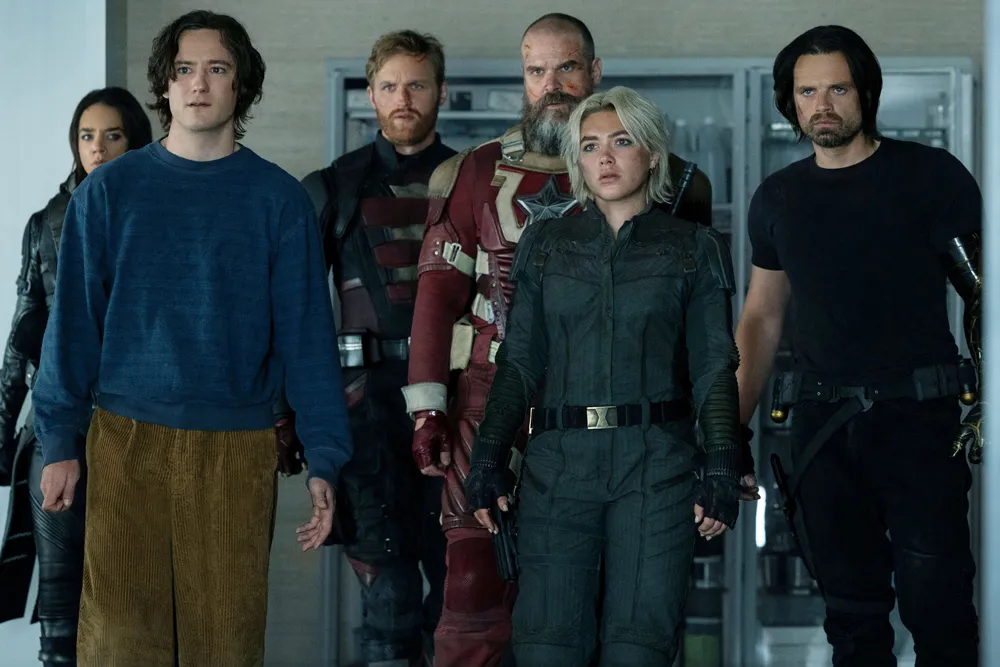
After a run of uneven entries, Marvel finds itself in need of something that feels a little different, and Thunderbolts* arrives with exactly that intention. It’s not a full reinvention, but it does offer a shift in tone, trading polished heroics for something rougher, more character-driven, and at times unexpectedly vulnerable.
A team built from the leftovers
If you’re wondering who exactly the Thunderbolts are, you’re not alone, and the film knows it. This is a team made up of antiheroes, side characters, and figures pulled from across the Marvel Cinematic Universe, many of whom feel like they’ve been waiting for a second chance. At the centre is Yelena Belova (Florence Pugh), still carrying the emotional weight of her past and easily the film’s strongest anchor. Around her is a mix of familiar faces, including Alexei (David Harbour), her larger-than-life, often chaotic father figure known as Red Guardian, John Walker (Wyatt Russell), still dealing with the fallout of his failed Captain America stint, Ghost (Hannah John-Kamen), and fan-favourite Bucky Barnes (Sebastian Stan), who perhaps understands better than anyone what redemption actually costs. It’s a deliberately scrappy line-up, and that’s part of the appeal. These aren’t polished heroes, but people trying, often unsuccessfully, to be better.
A story that leans into its flaws
The plot itself can feel uneven, with moments where the pacing shifts abruptly or certain beats feel a little too neatly placed. But there’s also something refreshing about how contained the story is compared to recent Marvel entries. Rather than building towards something endlessly expansive, it focuses on this group and the dynamic between them. There’s a clear effort to explore themes of trauma, identity, and self-worth, even if those ideas sometimes sit quite close to the surface. The film doesn’t always trust itself to go deeper, but when it does, it works.
Florence Pugh holds it all together
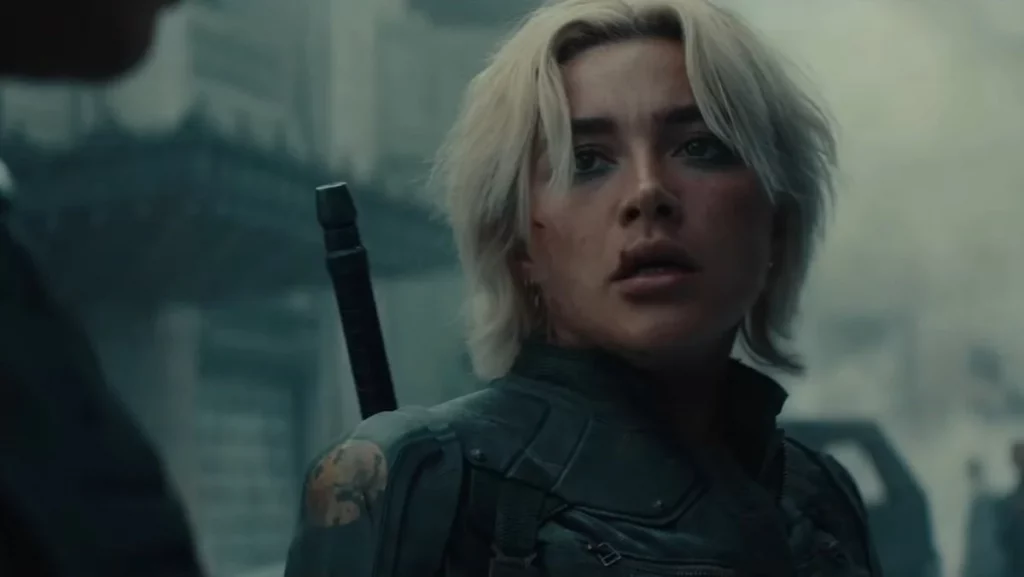
More than anything, Thunderbolts* works because of Florence Pugh. She brings a level of sincerity that cuts through the film’s more uneven moments, grounding Yelena in something that feels real. There’s a quiet weight to her performance, particularly in the moments where she isn’t saying much at all, and she manages to balance the film’s humour with something more emotional without it ever feeling forced. It’s not an easy line to walk, but she makes it look effortless. Alongside her, Lewis Pullman’s Bob adds an unexpected layer to the story, his vulnerability and instability becoming central to where the film eventually goes. Their dynamic gives the film its strongest emotional thread.
A different kind of Marvel tone
There’s still humour here, of course, but it feels more in line with the characters rather than constantly undercutting the tone. The action, too, feels slightly more grounded, even when the stakes rise. It doesn’t entirely escape the familiar Marvel formula, particularly in its larger moments, but there’s a noticeable attempt to shift the focus towards character rather than spectacle. It’s not a complete transformation, but it’s enough to make it stand out from some of the more recent entries.
CultureCues Standout Moment
The film’s most memorable sequence comes later on, when the action becomes far more internal as the team confronts Bob’s darker alter ego, the Void. The setting transforms into a surreal, almost dreamlike space, what Yelena refers to as “interconnected shame rooms”, where each character is forced to face the parts of themselves they’ve been trying to ignore. It’s an ambitious moment, both visually and emotionally, moving away from traditional action and leaning into something more psychological. The film doesn’t always fully land the balance between concept and execution, but this sequence stands out for how clearly it commits to its central idea, that these characters aren’t just fighting a villain, but confronting themselves. It’s where the film feels most honest.
It also mirrors the film’s striking opening, where Yelena throws herself from a towering skyscraper, setting the tone for a story as much about inner conflict as physical survival.
Final thoughts
Thunderbolts* is not without its flaws. It can be messy, uneven, and occasionally frustrating in how it handles its ideas. But it’s also one of the more interesting recent Marvel entries, largely because it’s willing to slow down and focus on its characters. There’s something endearing about its imperfections, and while it may not redefine the franchise, it does offer a reminder that these stories can still work when they’re given space to breathe. It might not be perfect, but it’s a step in the right direction.
And for Marvel fans, it goes without saying, don’t rush out when the credits hit.
Thunderbolts* arrived in UK cinemas on 1 May 2025.

Nikki Murray is a UK-based writer, screenwriter and founder & editor of CultureCues, covering film, television, music and pop culture. Her work focuses on storytelling and the moments shaping modern entertainment.